
Archaeologists Keep Finding Women Where Men Were Supposed To Be
Even when historical records already suggested they’d be there

The Noösphere is an entirely reader-supported publication that applies recent social science research to the cultural, political, and technological issues shaping our world today. If you read it every week and value the labour that goes into it, consider supporting it by liking or sharing this essay, becoming a paid subscriber or buying me a coffee! Thank you!
History has a funny way of becoming decidedly less male-dominated the moment we stop assuming it always was.
Take ancient Rome, for instance. Despite the legal, economic, political, and social restrictions imposed on Roman women, many did play roles other than wife, mother, and daughter — including priestess, empress, midwife, shop owner, captain, and merchant. In a dedication dating to around 200CE, uncovered by archaeology professor Carrie Atkins, two Roman women described themselves as ‘distinguished matrons, Red Sea ship owners and merchants.’ Atkins has also found dozens more references to women just like them in other historical sources.
Just-published research by archaeologist Tamara Lewit adds yet another profession to that list: wine and olive oil producer. By analysing various Roman texts — laws, business records, grave inscriptions— spanning five centuries, Lewit found that the vilica, previously dismissed by historians as little more than a housekeeper, was actually a female farm manager overseeing wine and olive oil production, bookkeeping, sales, and other operations. As she writes:
Although no vilica has left us an account of her work in her own words, by paying careful attention to all the evidence available to us, we can hear an echo of her voice.
But that’s the thing; the evidence existed all along. The echoes — and the screams — of women occupying diverse, influential, and public roles, even within patriarchal societies like ancient Rome, were there. Yet only recently have we stopped treating them as background noise.
Ancient Romans were hardly unique in their determination to clip women’s wings. Ancient Greeks were, arguably, even worse, with the belief in women’s supposedly ‘innate’ intellectual, emotional, moral, and physical inferiority reverberating throughout much of Greek society.1 Now imagine their surprise, or perhaps sheer horror, when they encountered women who definitely didn’t fit that mould. Because they did encounter some.
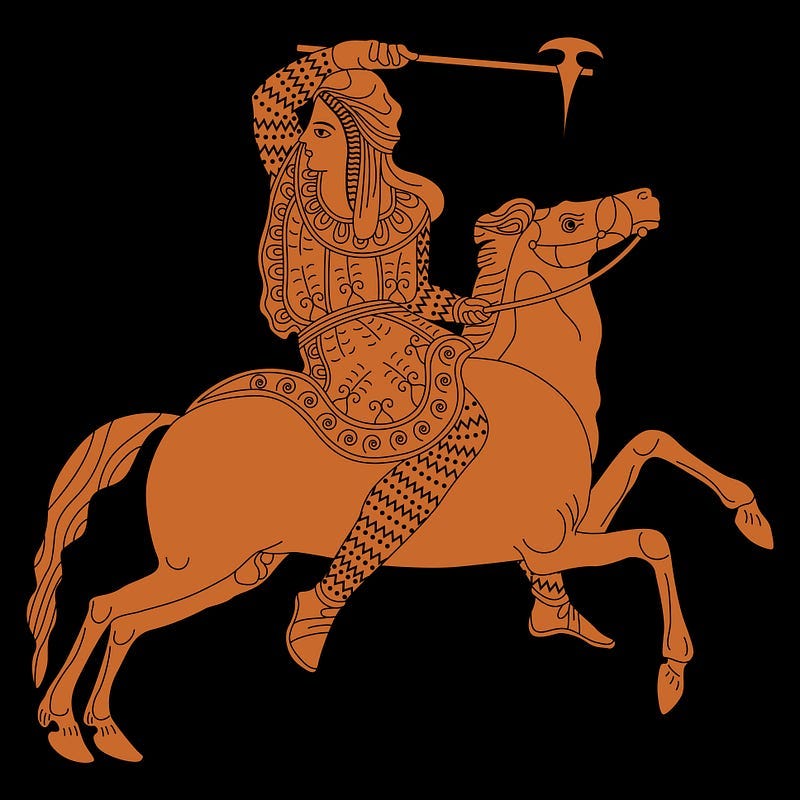
In Histories, written in the fifth century BCE, Herodotus — the ancient Greek historian and the ‘father of history’ — recounts how the mythical Amazons, female warriors and hunters, became entwined with the very real Scythian tribes, an Iron Age nomadic people of Eastern Iranian origin. Their descendants, the Sauromatians, carried on this tradition. According to Herodotus, Sauromatian women ‘kept to their primal way of life: they go out hunting, whether their husbands are with them or not; they go to war, and they dress exactly like the men,’ ultimately wielding ‘a power no less than that enjoyed by men.’ The Greek tragedian, Aeschylus, likewise described them as ‘the Amazons of the land of Colchis, the virgins fearless in battle, the Scythian hordes who live at the world’s end.’
Herodotus also reported, in no small detail, Scythian customs, burial rituals, and material culture — descriptions later corroborated by archaeological evidence.
One very recent example is a study published in Science Advances. Ancient DNA analysis2 of 85 individuals buried across 21 sites in Kazakhstan and Russia revealed that among elite individuals — a total of 37 — nearly half (42%) were female, suggesting that women could indeed attain high social status within Scythian society. One remarkable example is the ‘Princess of Urdzhar,’ found in eastern Kazakhstan with an elaborate gold headdress, a stone altar, and medicinal plants, pointing to her likely role as a spiritual leader, priestess, or healer. Additionally, the study found no evidence that elite status followed either patrilocal or matrilocal residence patterns (that is, descent through the male or female line), suggesting instead a more complex form of social organisation — and one likely not based primarily around gender.
Previous ancient DNA analysis also revealed that many Scythian individuals scarred with battle wounds and buried with an assortment of spears, arrowheads, and horseback riding equipment were women as well. One such burial, discovered in 1988, was initially assumed to belong to a 13-year-old boy. But it turned out to be the grave of a 13-year-old warrior girl. In another, archaeologists found both a man and a woman, but the weapons — a Scythian bow-case — lay only beside the woman. Yet curators at the museum concluded that the weapons must’ve belonged to the man next to her. As the museum display confidently informed visitors: ‘weapons were for men what jewels were for women.’
And it didn’t seem to matter, neither to these museum curators nor to many earlier scholars, that weapon-wielding, high-status Scythian women had already been mentioned in Greek historical sources. Those accounts were too often ignored or dismissed as mere myths.
But the Scythians aren’t an isolated case of evidence being overshadowed by androcentric assumptions. A remarkably similar pattern emerges in another Iron Age society renowned for its warrior culture: the Celts.
Ancient Roman writers described the Celts, whose territories stretched from the British Isles across Western and Central Europe, as fierce warriors and ‘primitive barbarians.’ But it was Celtic women who seem to have particularly fascinated — or terrified — them. The Roman historian Ammianus Marcellinus recounted how Celtic women could ‘swing their robust and snow-white arms, using their feet and their fists and landing blows that seem triggered off by a catapult.’ They were also said to take multiple husbands, divorce, inherit property, hold positions of authority, and fight in battles — and just as courageously as men.
After all, some of the earliest recorded British rulers were women, too: Cartimandua, queen of the Brigantes, and Boudica, queen of the Iceni, both of whom ruled in the first century CE.
Yet Roman accounts of Celtic female rulers and warriors were frequently dismissed as legend or propaganda — or, at least, until modern DNA evidence confirmed them. Recent research also suggests that many Celtic communities were likely matrilocal and matrilineal, with women remaining within their kinship groups, managing land and property, and likely inheriting both, while men joined them through marriage.
Still, Greco-Roman texts weren’t the only pre-twentieth-century sources to suggest that women across the world held positions of status and performed roles later assumed to belong almost exclusively to men.
By the mid-seventeenth century, European missionary reports from the American shores were already describing Indigenous societies as marked by an ‘equality of the sexes.’ 3 Similar observations also appeared later in the accounts of European explorers, traders, and colonists. In his 1724 work, Moeurs des sauvages américains comparées aux mœurs des premiers temps (‘Customs of the American Indians compared with the customs of primitive times’), French Jesuit Joseph-François Lafitau described Haudenosaunee (Iroquois) and Wendat (Huron) societies as a form of gynécocratie, meaning ‘rule by women.’ As he wrote:
Rien n’est cependant plus réel que cette supériorité des femmes. C’est dans les femmes que consiste véritablement la nation, la noblesse du sang, l’arbre généalogique, l’ordre des générations et de la conservation des familles.
(Nothing is more real however, than this superiority of women. It’s through women that the nation properly consists, the nobility of blood, the family tree, the order of generations, and the preservation of families.)
Fast forward to the nineteenth century, and an increasing number of scholars — including Johann Jakob Bachofen in Das Mutterrecht (Mother Right, 1861) and Lewis Henry Morgan in Ancient Society (1877) — assembled evidence from across the globe pointing to societies in which women occupied roles Europeans, at the time, considered unusual or scandalous.
But it wasn’t really until the last century that more echoes of our far more complex, and far less universally male-dominated, past began breaking through the wall of assumptions built around it.
As long as humans have kept records, it turns out, there have been queens, empresses, pharaohs, priestesses, female warriors, keepers of knowledge, women who captained their own ships (the Red Sea matrons) and ran their own businesses (the ‘housekeepers’ who turned out to be winemakers), and other women who supported themselves, sometimes living free of society’s otherwise patriarchal bonds.4 There have also been some patrilineal and patrilocal societies in which women enjoyed considerable freedom and autonomy. And societies in which class and rank superseded gender or in which neither class nor gender likely mattered as much. And matrilineal and matrilocal communities across North and South America, Asia, and Africa, over a hundred of which still exist today.
The surprising part isn’t really that women occupied all these various roles and positions, but that we continue treating them as exceptions to the rule, even as new archaeological methods challenge that idea over and over again. As Angela Saini writes in her brilliant book The Patriarchs:
What’s odd is how hard so many scholars even today try to dismiss evidence of working, independent women or powerful women rulers and warriors in the ancient record. It is almost as though history doesn’t make sense to them unless women are powerless and invisible.
Today, male‑centred narratives of the past also persist beyond academia. And perhaps nowhere is this rigid vision of history more enthusiastically embraced than in the ‘manosphere’ — the online ecosystem of misogynistic men’s forums and sites.
To justify its belief in the universality and inevitability of patriarchal structures, the manosphere often relies on biological essentialism, the idea that there are immutable, biologically hardcoded differences between women and men, including in behaviour and abilities. ‘Weapons are for men what jewels are for women,’ in other words, because only men supposedly fight, hunt, and lead, and only women care about aesthetics.
Well, considering that school curricula already underrepresent women — in the UK, women are absent from a majority of history lessons, while in the US they appear in only a fraction of historical content — that many people struggle to recognise even key female figures in history, and that some scholars, as Saini points out, continue to view the past through a heavily male-centred lens, the manosphere doesn’t need to try hard to convince its followers that women contributed little of importance throughout history.
However, the manosphere’s insistence on universal male dominance also leads to another familiar conclusion: that women’s increasing empowerment is a violation of the natural ‘order of things,’ with disastrous consequences for society, especially men. Ancient Greeks actually worried about this, too. This is what classical scholar Froma Zeitlin described as the ‘Amazon Complex’ — the fear that women rejecting their ‘natural’ subordinate roles will result in a total female domination and male enslavement or extinction. Thousands of years later, some men seem to be grappling with the same anxiety. Some cultural fears die hard.
But if even in staunchly patriarchal societies, and not just in the ancient world5, women still repeatedly navigated a maze of gendered codes and laws to pursue activities we now associate primarily with men, how ‘hardcoded’ can these biological differences really be? To manufacture a story in which gender roles are the inevitable result of fixed biological rules requires an almost impressive amount of ignorance of the historical evidence and the messy, complex realities of human lives.
Because once you set aside the baggage of assumptions, you’ll find that women and men have always lived lives far more complex than the black-and-white (or rather, pink-and-blue) caricatures we try to fit them into.
Although the Roman vilica produced wine, Roman women were, at various points, forbidden from consuming it, likely due to beliefs that alcohol could affect their virtue, making them unfaithful to their husbands.
Women have certainly been denied an awful lot of things throughout history. But perhaps nothing quite as significant and enduring as the recognition for the societies they helped sustain and build.
Although not all Greeks. Sparta, for instance, celebrated ideals of ‘equality,’ and Spartan women enjoyed some rights that other Greek women didn’t. Still, Spartan society was also dependent on the labour of the helots—state-owned serfs. Not exactly the egalitarian utopia it’s sometimes portrayed as.
It’s an analysis of DNA recovered from biological samples, primarily teeth and dense bones, which preserve genetic material particularly well.
For example, the extensive, multi-volume Jesuit Relations, a collection of missionary reports that began being published in 1632, documenting the lives and societies of Indigenous peoples in what was then New France (present-day northeastern United States and Canada).
For a long time, though, unattached and financially independent women in the ancient world were often assumed to be prostitutes or courtesans. Modern research, however, including work by scholars such as Julia Assante and Stephanie Budin, has shown that this interpretation wasn’t always supported by evidence.
Yes, I’m looking at you, Victorian era. Despite the ideology of the ‘separate spheres’ and the ideal of the ‘idle’ lady, many women worked, up to a third owned businesses, and others were inventors, scientists, writers, artists, etc.
The line about Celtic matrilineal communities (women managing and inheriting land, men marrying into their kinship group) is s real triumph for women. Inheritance law reveals what a society actually believes about who counts as a durable legal person, and being centered in an inheritance system is no small feat. Roman and English law went in the opposite direction, through coverture and primogeniture, manufacturing a "natural order" rather than reflecting something more organic and reflective of practice. The erasure this piece traces in archaeology is of a piece with the erasure of women in legal systems that spent centuries writing women out of inheritance (along with the ability to be remembered through conventional legacies).
"History has a funny way of becoming decidedly less male-dominated the moment we stop assuming it always was."
"History: a set of lies agreed upon." —Napoleon
History is whatever "The Narrative" needs it to be in the moment. It's lies all the way down that morph into other lies as much as needed along the way.