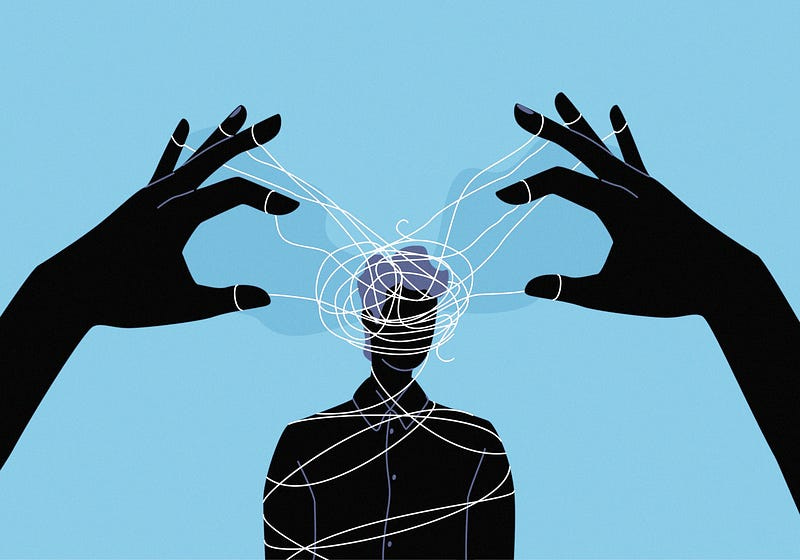
Distraction Is the Whole Point
How the deluge of irrelevant and misleading information keeps us from focusing on what truly matters
The Noösphere is an entirely reader-supported publication that brings social sciences research into frequently overlooked topics. If you read it every week and value the labour that goes into it, consider liking or sharing this essay or becoming a paid subscriber! You can also buy me a coffee instead.
Last week, President Donald Trump signed an executive order banning paper straws.
No, I didn’t exactly seek out this information. It crept into my feed, and instead of ignoring it, my eyes and mind betrayed me, lingering on yet another piece of manufactured noise disguised as news.
This whole plastic vs. paper straw debate is itself a distraction, too. Plastic pollution is undeniably a massive issue, that’s true, but plastic straws make up only a tiny fraction of the problem. In the ocean, for instance, they account for just 0.025% of the 8 million tons of plastic trash. Ban them or unban them — the overall impact remains rather negligible, while the world’s biggest plastic polluters continue their damage unchecked.
Still, whether it’s debates over minor sources of plastic waste or news about those debates or sensationalised political theatrics packed with ‘alternative facts,’ baseless claims, and outright fiction, so much of today’s information landscape seems to serve one purpose only: to distract us from what truly matters. Of course, somewhere in the mix, there’s still the real real news and stories that actually warrant our attention. But trying to find them is like searching for plastic straws in an ocean full of plastic waste.
And that’s exactly the point, isn’t it?
Wind turbines kill around 200,000 birds annually in the US alone. That might sound like a big number — and perhaps a valid reason to reconsider our increasing reliance on wind energy instead of fossil fuels.
But here’s another statistic to keep in mind: cats, those cute little predators we let sleep in our beds, kill an estimated 2.4 billion birds per year. Collisions with glass buildings and vehicles account for nearly a billion more. Meanwhile, oil production, specifically oil pits, kills up to a million birds annually — nowhere near as many as cats, but still five times more than wind turbines. If you’re a true avian aficionado, your energy would clearly be far better spent campaigning against free-roaming cats or pushing corporations to make their infrastructure more bird-friendly rather than trying to ban wind power.
Yet, the ‘wind turbines are killing birds’ narrative has been quite popular in recent years, pushed primarily by Republicans — including President Trump himself — and right-wing media outlets. And, surprise, surprise, many of these same voices happen to receive hefty donations from the fossil fuels industry.
In a recent paper published by Cambridge University Press, philosophers of science Cailin O’Connor and David Peter Wallis Freeborn argue that this is a clear example of what they term ‘industrial distraction.’ In a nutshell, it’s various techniques big corporations — and their handmaidens — use to shift public focus and policy in their favour. This usually involves funding and promoting research that, while technically accurate and high-quality, can be misleading. And as O’Connor and Freeborn note, it takes three main forms:
At its heart, industrial distraction involves changing how targets understand some causal system in the world. Typically it shifts public understanding towards some distracting potential cause of a public harm, and away from a known industrial cause of the same harm. A second variation uses inaccurate information to introduce distracting mitigants of industrial harms. And a last variant shifts public beliefs about downstream effects of policies to focus on distracting harms they may cause.
The impact of wind turbines on bird life is an example of the latter type of distraction. If you want the public to second-guess the transition from fossil fuels to renewable energy sources like wind — obviously undesirable for the fossil fuel industry — you can highlight some of the harms it causes, such as bird deaths. So what if cats, glass buildings, and oil production kill far more? If you don’t know that, the damage caused by wind turbines seems disproportionately alarming. And it shifts the focus away from renewable energy’s much larger environmental and societal benefits.
Another prominent example of industrial distraction — the first variant identified by the paper’s authors — involves the tobacco industry. To distract from the well-established link between cigarettes and lung diseases such as cancer and emphysema, the industry promoted research into their alternative causes, including asbestos exposure, air pollution, coal smoke, household products, and… early marriage. As one tobacco executive remarked, ‘doubt is our product.’
The sugar and dairy industries employed a similar tactic. Ironically, while the sugar industry funded research on the link between dietary fat and heart disease, various companies in the fatty foods sector funded research on the connection between sugar and heart disease. If you can’t fight what they say about your product, simply change the conversation. Even if only slightly.
But although the research publicised by large corporations isn’t necessarily always fraudulent — and can even contribute valuable insights — there are cases when it is inaccurate or even blatantly false.
The plastic industry has known for decades that recycling is neither an economically nor technically viable solution for managing plastic waste. But as Davis Allen, an investigative researcher at the Center for Climate Integrity — which recently published a detailed report on the topic — pointed out, they didn’t need recycling to work; they just ‘needed people to believe that it was working.’ And so, they pushed false claims about the effectiveness of plastic recycling through various marketing campaigns.
After all, denying the existence of plastic waste wasn’t an option — the problem is too vast and visible. But you could instead claim to have a solution, even if it doesn’t work well (or works at all), to distract from the real issue and those responsible for it.
This is the second type of industrial distraction O’Connor and Freeborn discuss in their paper. The tobacco industry used a similar tactic with cigarette filters, while the sugar industry did the same by promoting the idea of a ‘tooth decay vaccine.’ (No, such a thing doesn’t exist even today.)
Whether straightforwardly misleading or based on legitimate research and facts, information deliberately used as a distraction can become quite a powerful weapon, shaping which issues get addressed — and how — and which ones conveniently fade into the background.
And it’s not just big business that understands this.
Although economic inequality has been worsening for years, with 71% of the world’s population now living in places where it’s on the rise, while the ultra-rich only continue to hoard more and more wealth, proposals for minimum wage increases or higher taxes on the wealthy — two obvious solutions — are notably absent from the agendas of many political parties. Instead, much of the focus has been on entirely different ‘solutions.’ People living paycheck to paycheck, drowning in debt, and unable to afford a home are being told to direct their frustration at… other people who also live paycheck to paycheck, are drowning in debt and can’t afford a home. Immigrants ‘stealing jobs’ and ‘causing the housing crisis’, women ‘pushing men out of the workforce’, minority groups ‘raising prices’ through diversity, equity and inclusion initiatives, etc.
This is no different from the tobacco industry highlighting asbestos as a lung disease risk or the sugar industry blaming dietary fat for heart disease. It’s the same tactic with the same goal: to distract people from the real causes of widening inequality and from real solutions by offering convenient scapegoats.
Then there’s also the flood of political decisions and proposals that serve no real purpose and have no real benefit to people’s lives yet come to dominate the news cycle — like President Trump renaming the Gulf of Mexico or proposing a takeover of Greenland. What we’re witnessing in the US right now — as well as in other countries experiencing an authoritarian resurgence — is a textbook example of ruling by distraction.
As political scientist Adnan Rasool, who coined the phrase, explains:
In a ‘rule by distraction’ situation, the survival of the administration depends on people not being able to process the complete information. By creating multiple simultaneous distractions, the administration overloads the attention of its citizens. In essence, then, they are not lying to the people, they are just creating enough alternative explanations that ‘truth’ becomes debatable.
As a result, we tiptoe around deeper systemic issues like economic inequality and fail to challenge the relentless pursuit of wealth and power — the root cause of many other massive crises, including climate change — because it’s getting harder to connect the dots. We’re too distracted. Too overwhelmed. Too focused on the wrong fights.
And what truly demands our attention remains buried under all that noise.
Humans don’t have unlimited attention spans. We can only process so much before our mental bandwidth is overwhelmed, making us more susceptible to misleading or outright false narratives — especially when those narratives align with our existing beliefs or when we’ve encountered them before already.
Research backs this up, too. Information overload can lead to emotional and physical exhaustion, poor decision-making, and even significant declines in cognitive performance. Meanwhile, the constant fragmentation of our focus — what sociologist Linda Stone called ‘continuous partial attention’ — has been shown to impair working memory and reduce cognitive flexibility, ultimately hindering our ability to process information well enough to understand it.
This is the great paradox of our information age: we’re inundated with more information than at any other point in human history, yet that doesn’t necessarily mean we’re better informed. The sheer volume of information — as well as mis- and disinformation, much of it now also generated by AI — drowns out the broader context we need to make sense of it all. Instead of clarity, we get chaos. Instead of knowledge, we get noise.
I imagine many of us, especially right now, feel overwhelmed, confused, or both by the relentless barrage of news.
I know I do.
And that’s exactly the point.
Hitler considered ‘mental confusion, contradiction of feeling, indecision, panic’ as one of the greatest weapons in existence. And he was right. It’s precisely when we are pushed to our limits — emotionally, mentally, cognitively, or even physically — that we become more reactive than reflective and more susceptible to manipulation. Worst of all, we may not even realise what’s actually happening behind the smokescreen of constant noise. This is what aspiring autocrats and illiberal politicians rely on. It’s not just divide and conquer. It’s distract, divide and conquer.
Unfortunately, resisting this manipulation isn’t as simple as just turning off your phone or TV — though doing so more often certainly helps. Nor can we realistically expect governments or social media companies to regulate the spread of accurate information, even when it’s clearly being used to divert attention from real issues or real solutions to those issues. A potential remedy, as O’Connor and Freeborn suggest, could be requiring proper context alongside potentially misleading content. But let’s be honest: such regulations are unlikely to be proposed, let alone implemented, anytime soon.
Our best defence, as with so many other challenges, is arming ourselves with knowledge. And not just knowledge of facts but also how to critically evaluate the deluge of information coming our way. Recognising our own limits is crucial, too. The harsh truth is that no one is really immune to falling for misleading or false information — we’re all vulnerable.
In particular, if we rarely ever give our brains a break from the relentless stream of contradictory, conflicting, and inflammatory content.
Psychologist William James once noted:
The art of being wise is the art of knowing what to overlook.
That art has perhaps never been more essential than it is today.
In a world drowning in noise and distractions, our survival increasingly seems to depend on our ability to focus — on what truly matters, on what truly affects our lives and our world — and to recognise when we’re being led away from it.


This is an incredible write - thank you for sharing it!
great read thank you - it highlights what i term the stuffed and starved process - and it doesnt matter if you think of it towards food, information, or politics.. we are stuffed with overload .. and starved from good quality. The ability to 'fast' a while to 'eliminate' is essential! Before looking for the best quality we can find.