
Time Doesn’t Trickle Down Either
Why labour-saving technology, including AI, mostly fails to give us our time back


The Noösphere is an entirely reader-supported publication that applies recent social science research to the cultural, political, and technological issues shaping our world today. If you read it every week and value the labour that goes into it, consider supporting it by liking or sharing this essay, becoming a paid subscriber or buying me a coffee! Thank you!
Once upon a time, scribes spent hours crafting a single letter or other short document — preparing parchment, planning the layout, mixing ink, and then, finally, with quills in hand, committing the final strokes.1
If you couldn’t write yourself, or preferred not to, you also had to make the journey to a scribe and let them sweat over it on your behalf.
Then came cheap paper, rising literacy, and, in the nineteenth century, the fountain pen and the mighty typewriter. Writing a message no longer took several hours or days, but an hour or two. Fast forward to the digital age, and it takes mere minutes. With AI autocomplete and other tools, even seconds. But just as the time needed to write a message shrank, the volume of communication exploded. Typewriters both made writing faster and fuelled demand for a new clerical role: secretarial work. Instead of offices producing the same amount of correspondence and giving workers more free afternoons, they simply wrote much more—and hired people, mostly women, to manage the ever-growing pile of paperwork.2
Every new wave of technological innovation might arrive with the promise of less drudgery and more free time. Typewriters promised it well over a century ago. And so did washing machines. And vacuum cleaners. And personal computers. And now AI. Yet the long-promised golden age of leisure never seems to arrive, does it?
AI makes promises that are even grander than those of any technology before it. Techno-optimists insist it will soon ‘do everything,’ ushering in an age of abundance where we’ll all be healthier, smarter, and blessed with longer, more fulfilling lives spent entirely on pursuits of our choosing.
But this vision of utopia falls short when compared to reality. In a recent eight-month ethnographic study, researchers at UC Berkeley observed and interviewed employees at a 200-person technology company with broad access to generative AI tools. And they found that these tools did free up some time — only for that time to be quickly swallowed up by taking on more work. As one of the researchers, Xingqi Maggie Ye, observes:
They [employees] would run AI processes in the background while reviewing code, drafting documents, or attending meetings. Some even ran multiple AI agents simultaneously. This created a rhythm where both the human and the machine were constantly in motion.
In the interviews, the employees described feeling more capable after AI entered the picture — but also busier, more stretched, and less able to properly disconnect from work. Ye and her co-researcher, Aruna Ranganathan, argue that this can create a vicious cycle: the initial productivity boost eventually becomes the new normal. And as expectations rise to match workers’ expanded capacity, the job becomes denser, more demanding, and ultimately harder to sustain, not less.
A similar finding was reported in a 2025 study by the National Bureau of Economic Research (NBER). Analysing data from the American Time Use Survey between 2004 and 2023, the researchers found that workers in occupations with greater exposure to generative AI experienced significant increases in working hours alongside corresponding declines in leisure time. Between 2023 and 2024, moving from relatively low to relatively high AI exposure (from the 25th to the 75th percentile) was associated with an additional 3.4 hours of work per week and 3.7 fewer hours of leisure. Exposure to AI-powered workplace surveillance was linked to longer working hours as well.
Meanwhile, overall job satisfaction and work-life balance among AI-exposed workers — though measured using different data3 — declined during the same period. Coincidence?
In their paper, the researchers suggest that the reason technology-enabled productivity gains slip through our fingers and, paradoxically, can end up making us work more is that the benefits tend to be captured by employers or consumers rather than workers themselves. As they conclude:
Our analysis reveals a consistent pattern: workers in occupations with higher AI exposure end up working longer hours and enjoying less leisure time. This effect is particularly pronounced in contexts where AI significantly enhances marginal productivity and monitoring efficiency. It is further amplified in competitive labor and product markets, where workers’ limited bargaining power fails to keep up with productivity gains, with rents often accruing to firms or consumers.
Still, productivity gains aren’t even guaranteed. Another 2026 NBER survey of nearly 6,000 executives across Europe and the US found that although 69% of firms actively use AI, nearly 90% report no impact on productivity over the last three years. Some of the time AI supposedly saves is frequently instead spent on ‘botsitting’ and ‘workslop’ — correcting mistakes and hallucinations in AI-generated output— or offset by ‘AI brain fry’ —the cognitive fatigue that can accompany excessive reliance on AI tools.4
AI may also further intensify the workload of the very demographic already carrying more than its fair share: women.
Historically, it was women, in particular, who were expected to welcome technological innovation as their knight in shining armour. Take the washing machine, for instance. In the mid-twentieth century, it was celebrated as one of electricity’s biggest benefits, combining multiple chores — scrubbing clothes on washboards, boiling them in heavy pots, and then wringing them by hand — into a single machine-driven process, and rescuing homemakers (mostly women) from domestic drudgery.
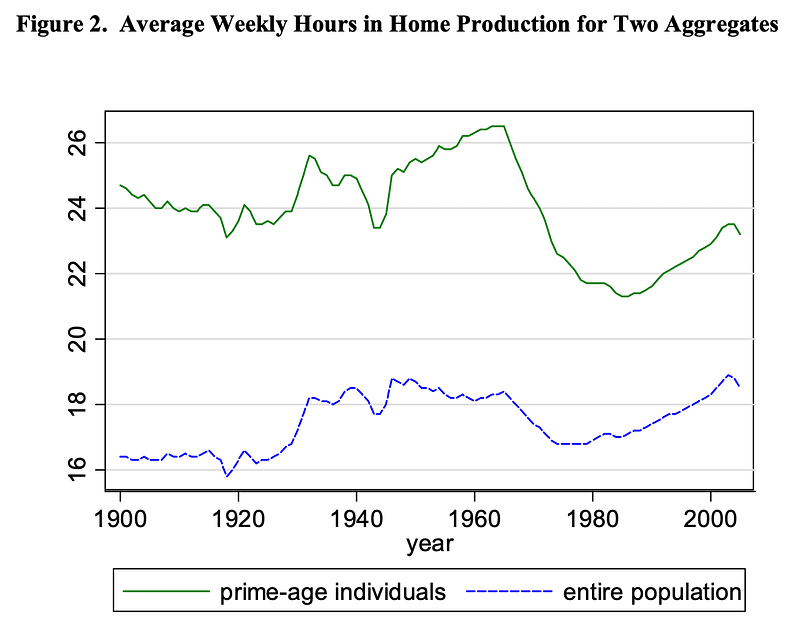
But as historian Ruth Schwartz Cowan argues in her 1983 book More Work for Mother, labour-saving appliances didn’t substantially reduce women’s domestic workload. Instead, they reorganised it and raised the standards women were expected to meet. Washing clothes takes less time? Well, now there’s no excuse for your child to walk around with even a single stain on their shirt. As Cowan writes:
Labor-saving devices were invented and diffused throughout the country during those hundred years that witnessed the first stages of industrialization, but they reorganized the work processes of housework in ways that did not save the labor of the average housewife. […] The nature of the work has changed, but the goal is still there and so is the necessity for time-consuming labor.
Time-use data from the US show that prime-age women (between the ages of 18 and 64) spent around six fewer hours per week on domestic and care labour between 1900 and 1965, and another twelve fewer hours by the early 2000s. However, prime-age men increased the time they devoted to household work over the same period. Overall, per capita time spent on domestic chores also slightly increased over the century.
Plus, the digital age has now brought new, gendered demands. A 2024 study published in the Community, Work & Family, examining European Social Survey data across 29 countries, found that women are almost twice as likely as men to juggle high levels of digital communication at both work and home, a phenomenon the researchers dubbed the ‘digital double burden.’ After all, it’s women who are still overwhelmingly expected to shoulder the bulk of emotional and mental labour in both spheres.5 And while secretarial and administrative jobs may have steadily vanished after the typewriter helped bring them into existence, the work they did hasn’t.
Someone has to handle the constant and increasing flow of digital correspondence and notifications and juggle the many apps and platforms and tools and group chats and keep track of the other online demands, and that someone is disproportionately likely to be a woman. And if AI, as we’ve already seen, increases both the volume of tasks and the expectations placed on workers, it risks exacerbating this digital double burden. The authors of the 2024 study believe so, too.
There are two paradoxes at play here: the Jevons Paradox and the Solow Paradox. On the one hand, efficiency gains can increase the use of a given resource, thereby creating more demand for workers’ labour (the Jevons Paradox). On the other hand, new technologies don’t necessarily translate into greater productivity (the Solow Paradox).
And the pattern seems remarkably consistent whether we’re talking about typewriters, washing machines, or AI — technology often does reduce the time and effort required for a specific task. But your plate rarely ends up emptier. It’s just refilled with different demands. And perhaps even more demands than before.
A 1911 advertisement for the Monarch Light Touch typewriter boasted that it allowed the female secretary to complete ‘a full day’s work at early morning’s speed’ without experiencing ‘three o’clock fatigue.’ But it also made clear who gets the biggest benefit — the employer, since ‘she puts more in the day’s work for you.’ At least this advert kept it real.
Over the last century or so, technological change has certainly allowed productivity to skyrocket. Since the 1950s alone, output per worker in the US has increased by nearly 300%. Yet neither median wages nor leisure time has seen a remotely comparable rise.
Meanwhile, as the chart below shows, average working hours in wealthy industrialised countries largely stopped declining around the 1980s. In some places, they even began rising again; in the US, hours worked per working-age person rose by about 150 hours between 1980 and 2000.
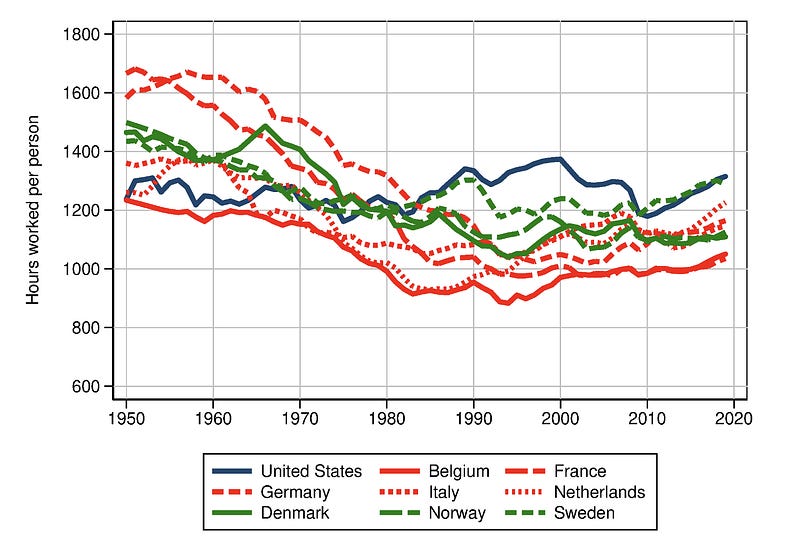
It doesn’t seem to matter all that much how many time-saving, productivity-boosting technologies we invent lately. Many of us are still stuck working 40-plus-hour workweeks. And women are still often coming home to a second shift that’s barely lighter than their grandmothers’.
Technology can promise whatever it wants, but it’s not up to technology to make good on that promise. It doesn’t decide (at least not yet) what happens to the time and effort it saves. That’s entirely on us, and on another kind of machine entirely— the socio-economic one.
Under capitalism and patriarchy, where institutions are largely organised around protecting the interests of those at the top, time doesn’t trickle down any more than money does. The hours saved by new technologies rarely find their way back to the people whose lives they were supposed to improve. Instead, they are transformed into higher expectations, more consumption, more paid and unpaid labour, and, ultimately, more profit. Sometimes they also produce even greater inequality.
And eventually we forget, or are urged to forget, about all the promises made along the way. A recent Wall Street Journal article, titled ‘Does leisure make us happy? Often the answer is no.’ seems to do that, nudging us to question the very thing technological progress was supposed to deliver. One day, some of us may even feel grateful for being treated like machines.
For the rest of us, though, getting off the hamster wheel, as great as it is for our well-being, gender equality, and the climate, isn’t as simple as stepping off. How many of us can afford to do that today anyway?
If we want technology to deliver on its promise, we need to start paying attention to who gets to keep the time, wealth, freedom, and other benefits it creates (and whether it creates them at all), and start measuring progress by the lives it improves, not just the output it increases.
Writing a message can now take seconds— but should it? I’d much rather have technology free me from countless other things than from spending hours writing a letter, cooking a meal, or tending to tomatoes in my garden. Not every activity is a friction to be eliminated. And sometimes, saving time can only end up costing us more.
Perhaps, at some point, AI or another technology will actually free us from a significant amount of unwanted work. But that is no guarantee that the people whose time is freed will get to keep it and write those letters.
And if we keep having to run faster and faster to stay in the same place, or not even there, we may eventually forget that the point was never to run faster. It was to live better.
Obviously, this varied enormously depending on the period, the scribe’s speed, the text’s length and complexity, the materials used, and so on. By some estimates, a late-medieval scribe in Europe could produce about three pages per day, meaning an average one- or two-page letter likely required several hours of work.
The typewriter also played a key role in women’s entry into the workplace, especially in office settings. Before the first commercial typewriters were introduced in the late nineteenth century, clerical work and office environments were largely male-dominated.
It was evaluated using employee reviews from Glassdoor, which include text and ratings (ranging from 1–5) across multiple dimensions.
I also wrote about some of the cognitive dangers of overreliance on AI tools in this piece.
Yes, that includes the workplace. One recent study found that the overwhelming majority (81.6%) of professional women in managerial roles spend at least 30% of their workweek on caring tasks. That’s more than a business day’s worth of work in a five-day week.
It's a hamster wheel of internalized shame over a weaponized Protestant work ethic.
Also, as David Graeber would say when discussing the 'bullshit jobs' theory, I think most office jobs, especially those held by men, involve more LARP-ing importance than actual work.
AI will enable and brainrot that to new heights of absurdity.
The work that can't be interfered with by AI is domestic and care work. That will continue falling more onto women. Men will be too busy chatting with their AI bots and pretending to be busy 'at work'.
Every tool that saved us time quietly signed a contract we never read: the time saved belongs to whoever we work for, not to us.